.png)

Press screening review: Michael


Michael, a sprawling and heavily scrutinized biographical drama directed by Antoine Fuqua. It delivers a brutal, brilliant, and triumphant portrait of the King of Pop. On the red carpet for the global premiere, a united Jackson family front flashed under the paparazzi bulbs. Prince and Bigi stood sharp in modern tailoring, flanking veterans like Jackie, Marlon, and Jermaine. The financial backing of the film bleeds through every frame, with industry estimates placing the budget near two hundred million dollars. The initial box office return of two hundred seventeen million dollars and a ninety-six percent audience approval rating confirm what the studio banked on: the world still hungers for Michael.

The weight of the narrative rests heavily on twenty-nine-year-old Jaafar Jackson. The nephew steps into his uncle's silhouette with an eerie, magnetic precision. He captures the soft-spoken vulnerability and the titanium-forged stage presence without slipping into cheap imitation. Sharing the burden is Juliano Krue Valdi, who plays the child prodigy with a raw, kinetic energy that grounds the early years. Together, they build a cohesive portrait of a life lived entirely under the blinding glare of public scrutiny.

Colman Domingo plays Joe Jackson with terrifying gravity. The heartbreak of the belt pounding on a young Michael evokes a deep, visceral empathy, laying bare the profound suffering inflicted by his father. This pain, juxtaposed with the complex backstory of rejoining the Jackson Five, offers a glimpse into intimate moments fiercely guarded for decades. Yet, the tension breaks brilliantly when needed. The room erupted in unanimous laughter during the scene where Michael fires his father via a simple fax - a quiet, devastatingly effective moment of independence. Nia Long brings a vital, grounding tenderness as the matriarch, while Miles Teller provides the fast-talking corporate armor as attorney John Branca.

Beyond the stage, the film constructs a portrait of a profound visionary. During the Thriller era recreation, Michael is shown as endlessly pleasant and dignified, a stark contrast to the demanding industry around him. His genuine dedication to visiting children in hospitals deepens the tragedy of his own shattered youth. And then there is Bubbles. The beloved chimpanzee is rendered in CGI, but the audience surrendered to collective aww moments regardless, proving the enduring charm of Michael's eccentric orbit. For a person who was never a big fan of Michael, the emotional weight of these scenes is entirely disarming. Watching this shattered childhood reconstructed on screen nearly brought me to tears on three separate occasions. The magic of Michael gets into you after knowing him closer.
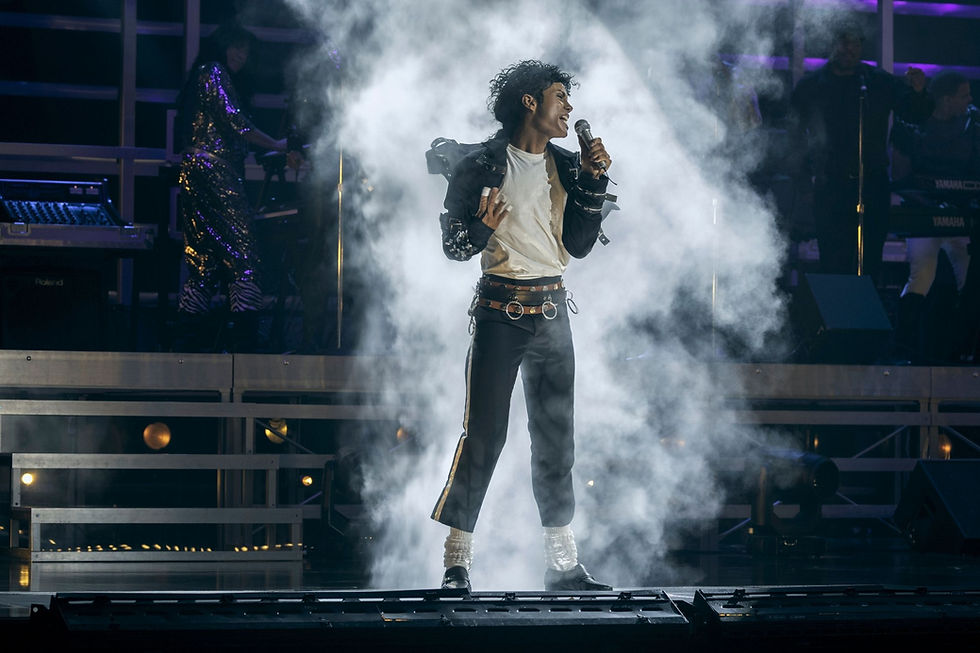
For the style-obsessed, the wardrobe is a standalone masterpiece. Costume designer Marci Rodgers compiled an eight-hundred-page research book to rebuild every look from the ground up. The saturated red leather, the heavy metallic zippers, the authentic Swarovski crystals, and the classic Levi's denim are all reproduced with obsessive exactness.
This meticulous wardrobe is already bleeding onto the streets. The standout is the black suit paired with a deep red armband - worn exactly on the left bicep. It is a razor-sharp look anchored by a slim black tie and flawless midnight tailoring. It serves as a powerful cultural signal, transitioning seamlessly from a premiere velvet rope to the sharpest events of the season.

Antoine Fuqua treats the material with reverence but keeps the pacing ruthless. The director masterfully captures the sheer magnitude of the stage through the eyes of Michael as a child. The audience can viscerally feel the crushing exposure of those massive platforms, understanding instantly that such a vast, echoing space demanded to be filled with relentless, authentic motion. Dion Beebe's cinematography shifts dynamically from the grainy nostalgia of Gary, Indiana, to the neon gloss of the high-pop era. Production designer Barbara Ling rebuilds history with staggering scale, particularly the colossal Motown and Wembley stages. The onscreen resurrection is so startlingly precise that family members at the global premiere expressed sheer disbelief, noting that it felt as though Michael himself was radiating directly from the screen. Tying the emotional journey together is Lior Rosner's score. The music operates as a lush, sweeping homage, connecting to Michael's catalog on a slower tempo that beautifully underscores the tragedy and the triumph.

Behind the camera, the editing process required its own monumental effort. Antoine Fuqua’s original assembly cut reportedly spanned over four hours, but the final release arrives at a tightly paced 130 minutes. This significant restructuring was guided by specific legal and narrative boundaries.
A planned third act covering the nineties was removed after the production and the Jackson estate navigated previous legal agreements restricting certain historical subjects. To keep the story focused, the team completed additional shoots, concluding the timeline gracefully in 1988 around the Bad album and the Victory tour.
While these adjustments meant leaving certain performances in the editing bay - such as Kat Graham’s portrayal of Diana Ross - it leaves the door open for the future. Industry sources suggest the studio is holding the preserved material close, with quiet discussions already circulating about a potential second film to cover the later chapters of his career.
The film succeeds because it leans entirely into the undeniable genius and the barrier-breaking artistry that permanently altered global culture. It is an immaculately constructed piece of cinema that gives the audience exactly what they crave: a front-row seat to undisputed musical royalty.