.png)

BARBARA DI MATTIA: THE UNCOMPROMISING VISION - An Italian-American Producer's Fight to Make Meaningful Cinema Profitable

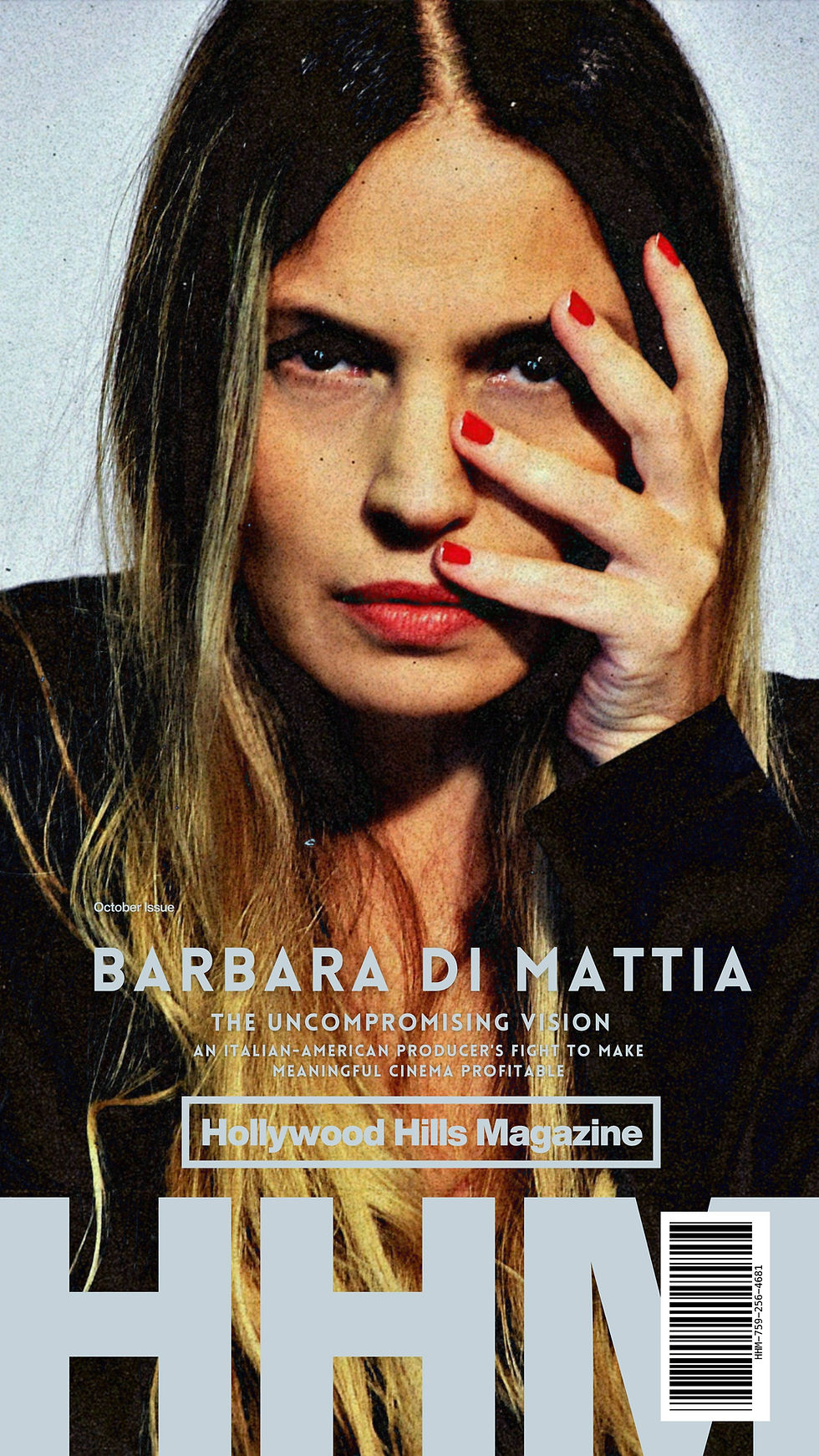
Barbara Di Mattia is an Italian-American producer based in Rome. Her work bridges art, emotion, and cultural identity, creating films that transcend borders, languages, and time.
Barbara, your career spans continents, from Venezuela to Italy to the United States. How did your journey in the entertainment world begin?
-I was born in Maracay, Venezuela, and grew up in Italy, in the Abruzzo region. My path started in Milan, where I worked as an actress and model before moving to Beverly Hills. Living in California opened a new chapter for me, that's where I began producing. For me, cinema is the highest form of artistic expression: it engages and envelops the viewer, drawing them into the story and allowing them to truly empathize with it. That's why I strive to tell stories that, in some way, can raise awareness about important issues.
You produced the backstage of the Oscar-nominated film The Postman - Il Postino. What did that experience mean to you personally and professionally?
-Il Postino will always be a masterpiece of Italian and international cinema. Massimo Troisi was one of the greatest Italian actors and directors of all time, an artist of immense sensitivity and humanity. The backstage, directed by Stefano Veneruso, his nephew and my partner in life and work, allowed me to witness the depth of that creative process. It's an experience that continues to inspire everything I do.

You also produced Starting Tomorrow I'll Get Up Late, available on RaiPlay. Tell us about that project. -Starting Tomorrow I'll Get Up Late was co-produced with Rai Cinema and is inspired by the life of Massimo Troisi. The screenplay was written by Anna Pavignano, Oscar nominee for The Postman - Il Postino who shared with Troisi an extraordinary artistic and emotional bond. The film Starting tomorrow, I'll get up late received the prestigious Premio Charlot and was presented at the magnificent Giffoni Film Festival, both milestones that confirmed how audiences still connect deeply with Troisi's poetic legacy. It was also presented at both the Italian Chamber of Deputies and the Senate, followed by a screening of the film.
Your new film, The Years of the Father, is co-written with Anna Pavignano and directed by Stefano Veneruso. What inspired this story?
-The Years of the Father tells the story of an Orthodox Jewish young man who leaves Jerusalem for Rome to meet the father he has never known and believed to be dead. It's a film that delves into one of the most universal relationships: that between a father and a son. It explores various emotions, starting from an indissoluble love and the invisible emotional bond that connects generations. Writing it together with Anna Pavignano was an extraordinary experience. The film, directed by Stefano Veneruso, features a wonderful cast including Massimo Bonetti, Daniel Bondì, Lee Levi, Arianna Aloi, and Florence Nicolas.
As an independent producer, what was it like to bring The Years of the Father to life?
-Producing The years of the father as an independent filmmaker was both a challenge and a lesson in perseverance. Making a film today requires enormous effort, and for independent producers it's even more complex, because, as the word says, we are "independent." We don't rely on the structures of big studios or networks; we build everything step by step, often driven only by conviction and passion. In Italy, thanks to the support of public institutions and ministerial funds, it's still possible to make meaningful films, but it's not easy. Bureaucracy, limited resources, and the competition for funding make every production an uphill journey. Yet, despite all of that, The years of the father exists, and that, to me, is already a small victory.

You have several projects in development, including 7 Dwarfs at Auschwitz and the animated feature Ciro & Peace. Can you tell us more about them?
-7 Dwarfs at Auschwitz is based on a true story, the incredible journey of seven Jewish dwarf siblings who were musicians and actors before being deported to Auschwitz. It's a film about resilience, identity, and the power of art and family to survive even in the darkest times. Ciro & Peace is a story that celebrates friendship, inner strength, and the power that love can have in shaping the destiny of a child, Ciro, and his beloved feathered friend Peace, a beautiful Ararauna parrot. It carries a message of hope and sacrifice, showing how a child can perform acts of extraordinary courage to find his faithful friend, a journey that begins in Mexico, passes through Italy, and ends in Ukraine, in the midst of war. Among my upcoming projects, there's also a film set in the magnificent city of Venice, a poetic and visually striking story linked to climate change, and a documentary about football, exploring the human and emotional side of the sport.
You've also brought theatre productions to life, such as Troisi Poeta Massimo. Tell us about that experience.
-Troisi Poeta Massimo is a play I hold very dear. I produced it with Istituto Luce - Cinecittà, and it's been on stage for several years, earning both public and critical acclaim. It celebrates Massimo Troisi not only as a filmmaker and actor, but as a poet of everyday life, someone who transformed simplicity into emotion.
You've curated exhibitions dedicated to Troisi in some of Italy's most iconic venues. What does that mean to you personally?
-I am truly honored and proud to have had the opportunity to help share his art with the public. Exhibitions dedicated to Massimo Troisi have been hosted at remarkable places like Castel dell'Ovo in Naples, Palazzo D'Avalos in Procida during Procida Capital of Culture, and the Teatro dei Dioscuri al Quirinale in Rome. Keeping his legacy alive is both a privilege and a joy.

Q: How do you see the role of women producers today in the global film industry?
A: I believe women bring sensitivity, intuition, and emotional depth to storytelling. But I'm also aware that, as a woman, I often have to work a little harder to earn the same recognition men receive more easily. There's still much progress to be made, even in a globalized world where bias remains. However, I also believe that hard work is the only real key, for men and women alike, to achieve anything meaningful.
Q: If you had to define your mission in one sentence, what would it be?
A: To make films that speak to the heart and remind us that humanity, in all its beauty and fragility, is our greatest story.
Q: What's next for you?
A: My focus now is on 7 Dwarfs at Auschwitz and Ciro & Peace, both of which I hope to bring to international audiences soon and I'm open to collaborations with producers, distributors, and institutions who share the same passion for authentic, meaningful cinema.
Photography: Marinetta Saglio Barbara Di Mattia Photography: Marinetta Saglio